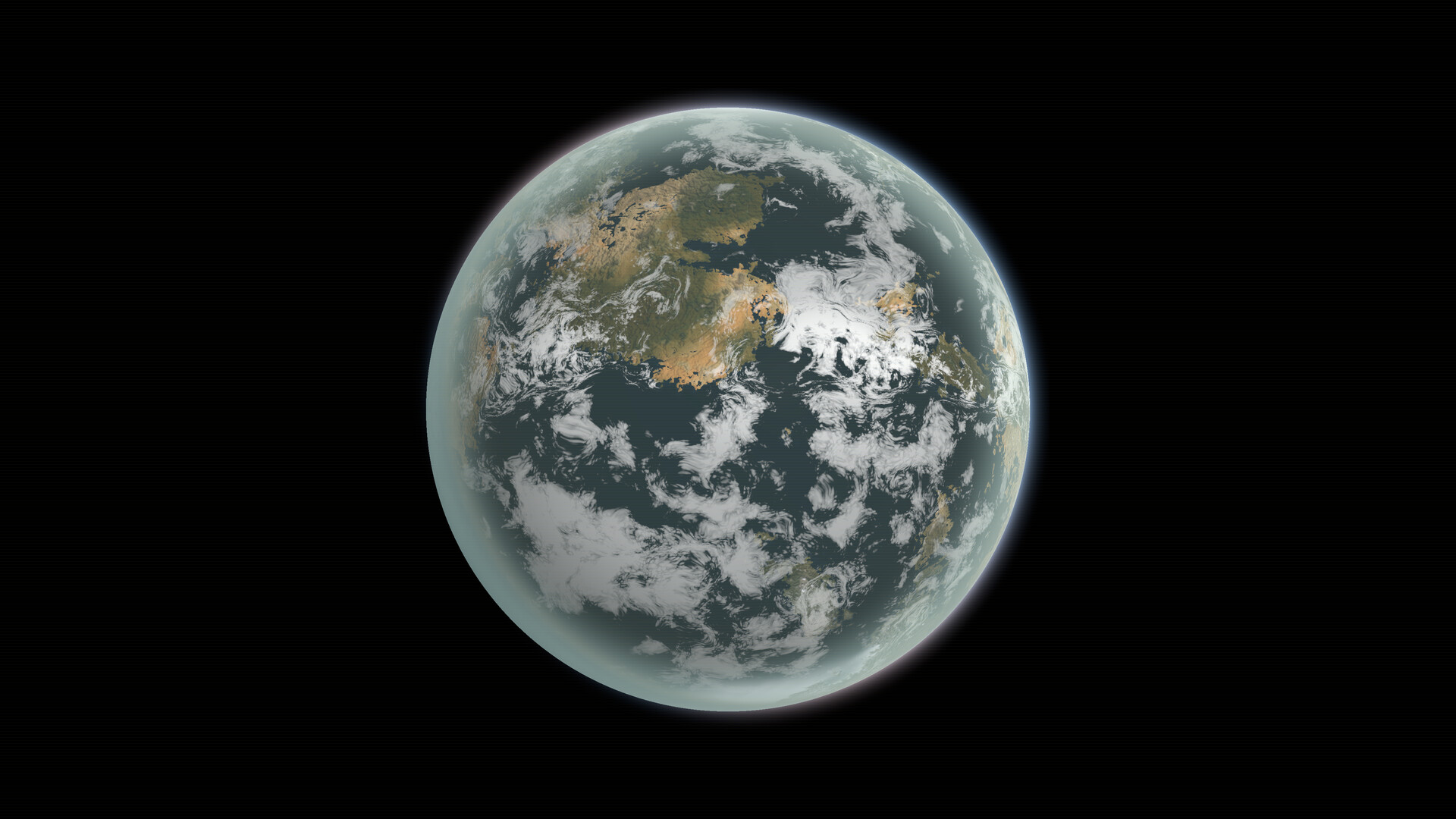
World Climate Lab
World Climate Lab puts a full climate model on your desktop. Give it any world and it works out the climate: where the winds blow, where the rain falls, where ice forms and deserts open, and how the oceans carry the heat. It runs live on your graphics card, and you watch the world settle into its climate, year by year, in a few minutes. Bring the map you have drawn and find out what its weather would really be. Or ask what if: what if Earth spun backwards, circled a red dwarf, or had a moon close enough to flood its coasts at every tide? Bring your own worldYour maps are more than pictures here. Each one tells the model something real about the world, and the climate answers. Heightmap: greyscale or colour, at any size; 16-bit maps keep every gentle slope, and mountains rise only as high as the planet's gravity and rock allow Sea mask: draw your coastlines exactly as you want them, whatever the heights say, or raise and lower the sea with a single slider Depressions mask: keep basins dry below sea level, like the Dead Sea or a Mediterranean cut off from the ocean; their air is denser and warmer, rivers run into them and end there, and lakes form where the water allows Sea floor: upload a bathymetry map and the tides follow it, piling up in shelf seas and ringing in resonant bays; without one, the game builds continental shelves, slopes and abyssal plains for you Earth comes with its real coastlines and its real sea floor Or build oneThe Topography Creator is a full terrain editor inside the game. Start from a blank ocean, import a map, or generate a world of drifting plates Sculpt on the globe with 73 brushes, stencils and a library of generated landmasses Reshape the whole planet with a height curve, then erode it and carve its river valleys Trace over reference images with guide overlays Export your terrain as 16-bit maps, or send it straight to the simulation Any star, any orbit, any skyA planet circling two suns, a moon kept warm by tides alone, a world tipped on its side: set it up and the climate follows. Stars from cool brown dwarfs to hot blue stars, old white dwarfs, and pairs of stars Each star's own light reaches the climate: a red dwarf's infrared warms snow and ice differently from sunlight Any distance, eccentricity and season of closest approach Tilt up to 180 degrees, so a world can spin backwards and see its sun rise in the west Any day length, a face locked to its star, or the 3:2 spin Mercury is held in A planet or a moon, with up to three moons of its own raising tides and warming it from within Air from a trace to 100 bar of nitrogen, carbon dioxide, hydrogen or methane, with ten trace gases from oxygen to ammonia An atmosphere profile that shows whether a person could breathe there, and why not Watch it settleEvery change ripples through the whole system. Slow the spin and the climate bands widen. Lock the world to its star and it splits into a warm day side and a frozen night side. Thicken the air, move a coastline or dim the star, and the world finds its new climate. The Energy Flow view traces where the planet's energy goes and tells you whether the world has settled, is still warming or cooling, or is running away. 22 ways to read a worldEvery map comes from the same run, so the rivers follow the rain, the forests follow the water and the ice follows the cold. Surface: topography, rivers and lakes, ice cover Satellite: a true-colour view from space, with clouds, a night side, and plants coloured by their own star's light Vegetation: vegetation cover and soil moisture Climate: climate zones, temperature, rain and snow, aridity Atmosphere: pressure, cloud, winds, humidity, dew point, wet-bulb heat and the energy budget Oceans: surface and deep currents, current paths and tides Hover anywhere for the numbers, step through the seasons of the orbit, switch between map and globe, and show temperature, rain and pressure as contours. Climates Earth never hadEarth's climate zones describe one kind of world. Here, Earth-like worlds get Köppen's 31 classes, while slow-turning and tidally locked worlds get systems of their own, built for places where day and night replace the seasons: twilight cloud forests, frozen night wastes, and seas from permanent ice to boiling water. Take it with youPlain maps or framed posters with title and key, up to 8192 by 4096 Every layer at once, or a full year of seasons Animations of a year of clouds, winds, currents, temperature or rain The climate itself as data for other software: temperature, rain, snow, soil water, climate classes and more, yearly and month by month A seamless year of cloud maps at 8192 by 4096 for animation Checked against EarthThe Earth preset, with its real coastlines and sea floor, is measured against the observed climate zones of 1991 to 2020 whenever the model changes. A Data Bank of illustrated pages explains every control, the climate systems, and what the model does and does not simulate. A Detailed model with a twelve-layer deep ocean is available as an experimental beta. Made to run on your machinePerformance settings for laptops and older graphics cards, which change the pace but never the results Interface size from 75 to 300 percent English, French, Spanish, German, Polish, Russian, Simplified Chinese and Traditional Chinese