
Salt of the Earth
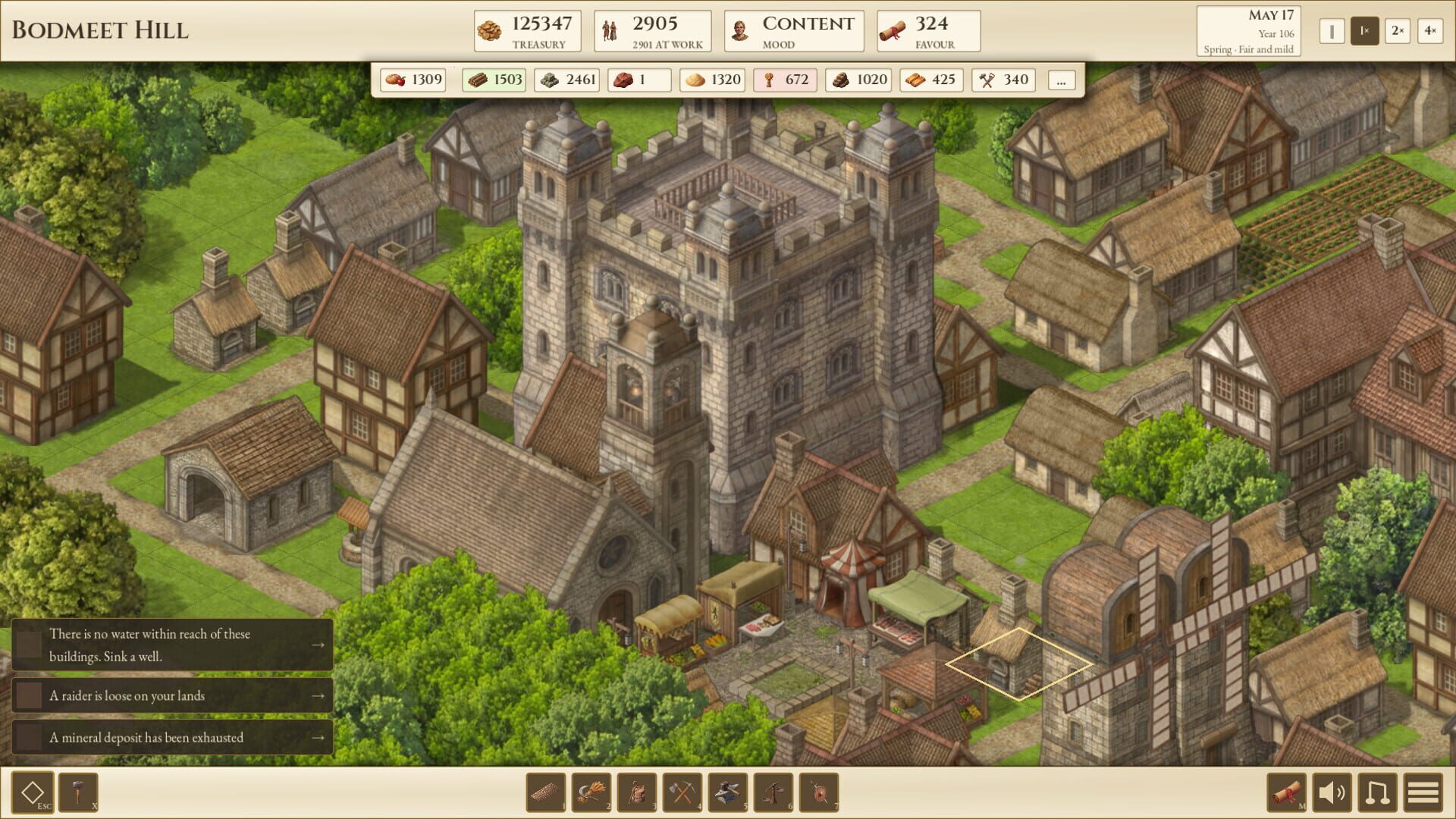
Salt of the Earth is an isometric medieval settlement builder about a single manor held by charter, and the families who live on it. Houses rise from hovel to town house when the household inside is fed and looked after. Workshops take their labour from the houses within walking distance. Every building has to touch the road network. The year turns through four seasons, and nothing grows in winter, so the food stored before it has to last until spring. Traders, tithe collectors, couriers from neighbouring towns and raiders all turn up at the manor, and the neighbouring towns remember how you dealt with them. Key FeaturesMore than forty buildings, all of them on a road — From a hovel and a well up to a cathedral, a keep, and border outposts on the edge of the shire. Placement determines output: a workshop draws its workers from the houses near enough to walk, so a yard two streets too far from housing stands idle while the one beside it runs full. Housing that upgrades as needs are met — Four tiers, hovel to peasant house to half timbered house to town house. A household moves up a tier when its needs are met: food, water, a market in reach, a church, an inn, a school for the children. Variety counts as much as quantity, and a family living on bread alone eats through it far faster than one with bread, meat and fruit on the table. Families whose needs go unmet leave, and the yard behind the house goes unworked. No research tree — Each building unlocks once a building it depends on is standing: the bakery needs a mill, the tower needs a barracks, the school needs a church and a half timbered house, the goldsmith needs a town house. Industry can only grow as far as the housing does. Twenty eight goods and the chains between them — Grain to flour to bread, ore to iron to tools, clay to tiles, grapes to wine, wool to fabric. Surplus sells at the market square, and any good can be forbidden outright so the town stops eating what was meant for sale. Seasons and weather — Food is grown and stored from spring to autumn so the manor can get through the winter. Rain, hail, snow and thunderstorms come and go, and rain helps put out fires. Over fifty decision events — Each one brings someone to the manor with a request, and you decide how to answer. A company of masons, out of work since their abbey ran out of money, asks to be taken on. The bishop's collector asks for a larger tithe than usual. Families from the neighbouring manor wait at your boundary, asking to settle. Raiders and spreading fire — Raiders start arriving once the manor is a market town. They walk in from the edge of the map and set fire to the nearest building they can reach. Fire spreads between buildings that stand next to each other and stops at gaps such as roads. A well can put out one fire and then takes weeks to refill. To stop a raid, build towers and station soldiers in them. Four neighbouring towns that keep score — Couriers arrive with export offers once the manor is a market town. Each town has its own temperament: one is demanding and quick to take offence, another is patient. Relations with each town improve or worsen over the years, depending on how you deal with it. Four charters and five honours — Charters run from rich river soil to a lean northern frontier. Five honours carry the manor from Minor Lord to Castellan, each unlocking what follows: raiders and foreign correspondence at A Proper Market Town, border outposts and knights at Seat of Power.
Não recomendado para menores de 10 anos
Violência
